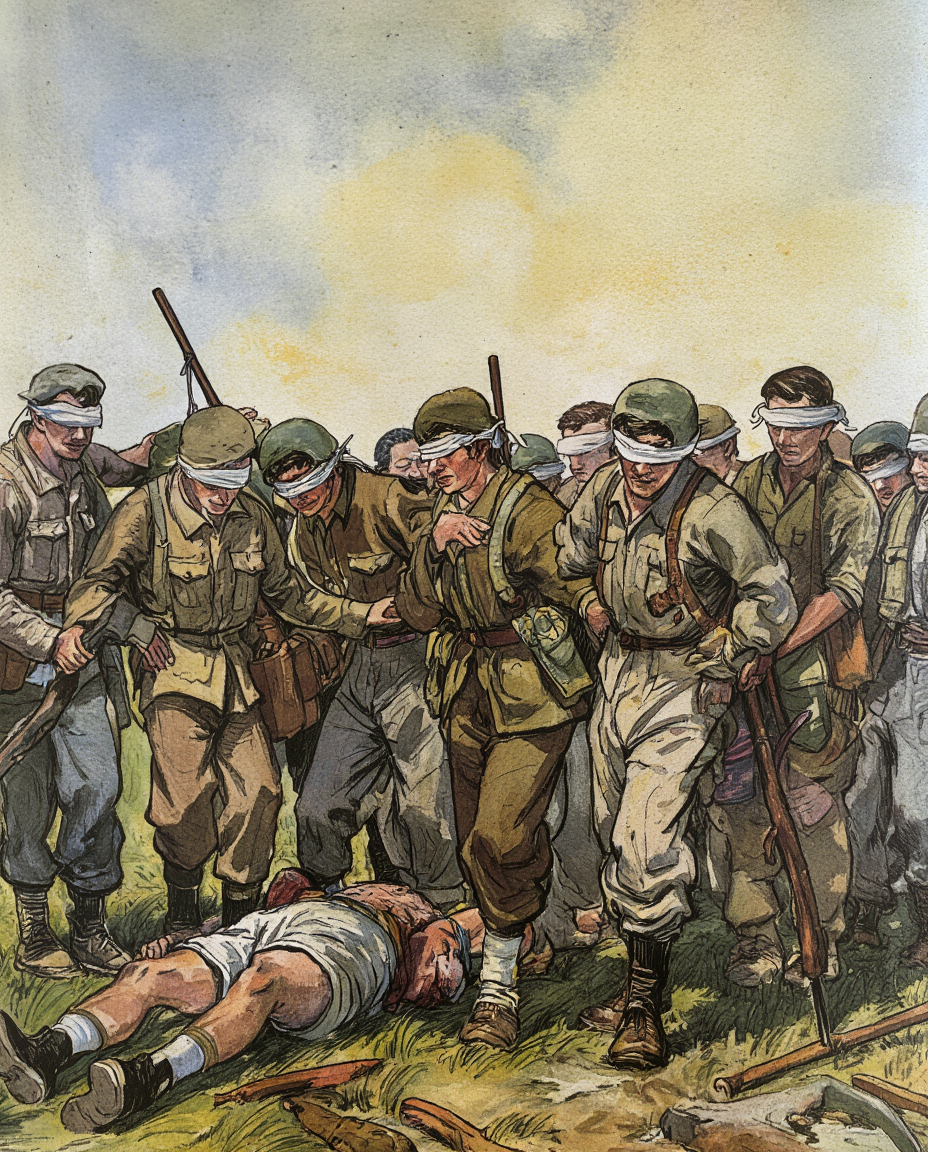
by Wilfred Owen
1
Bent double, like old beggars under sacks,
Knock-kneed, coughing like hags, we cursed through sludge,
Till on the haunting flares we turned our backs,
And towards our distant rest began to trudge.
Men marched asleep. Many had lost their boots,
But limped on, blood-shod. All went lame; all blind;
Drunk with fatigue; drunk with the misery of the trench,
Till the gas-shells dropping softly behind.
Explanation
This stanza paints a grim picture of soldiers during World War I. They’re exhausted, moving like old, broken men, not the heroic figures you might imagine. They’re weighed down by heavy gear (like sacks), coughing and struggling through muddy, slushy ground. The “haunting flares” are lights from enemy shells, reminding them of danger even as they try to retreat to a safer place to rest. The soldiers are so tired they’re practically sleepwalking, some without boots, their feet bleeding and sore. The phrase “drunk with fatigue” shows they’re stumbling, barely aware, overwhelmed by exhaustion. Then, gas shells (chemical weapons) start falling behind them, setting up the danger to come.
2
Gas! GAS! Quick, boys!—An ecstasy of fumbling,
Fitting the clumsy helmets just in time,
But someone still was yelling out and stumbling
And flound’ring like a man in fire or lime.—
Dim through the misty panes and thick green light,
As under a green sea, I saw him drowning.
Explanation
Suddenly, a gas attack happens. The soldiers scramble to put on their gas masks in a chaotic rush (“ecstasy of fumbling”). Most manage to get their masks on just in time, but one soldier doesn’t. He’s caught in the poisonous gas, screaming and staggering as if he’s burning or drowning. The narrator sees this through the foggy lenses of his own gas mask, describing the scene like the soldier is sinking in a “green sea” of toxic gas. It’s a vivid, terrifying image of helplessness and suffering.
3
In all my dreams before my helpless sight,
He plunges at me, guttering, choking, drowning.
Explanation
This short stanza shows the lasting trauma of the narrator. The image of the dying soldier haunts him in his dreams. The words “guttering, choking, drowning” describe the horrible sounds and movements of the soldier as he dies from the gas. It’s like the narrator can’t escape this memory—it keeps coming back, making him feel powerless.
4
If in some smothering dreams, you too could pace
Behind the wagon that we flung him in,
And watch the white eyes writhing in his face,
His hanging face, like a devil’s sick of sin;
If you could hear, at every jolt, the blood
Come gargling from the froth-corrupted lungs,
Obscene as cancer, bitter as the cud
Of vile, incurable sores on innocent tongues,—
My friend, you would not tell with such high zest
To children ardent for some desperate glory,
The old Lie: Dulce et decorum est
Pro patria mori.
Explanation
In this final stanza, the narrator speaks directly to the reader, imagining them experiencing the horror he’s seen. He describes throwing the dying soldier into a wagon, watching his face contort in pain, his eyes rolling, and hearing the awful gurgling as blood and foam come from his lungs. The imagery is gruesome, comparing the soldier’s suffering to cancer or the bitter vomit of animals (“cud”). The narrator is angry at people who romanticize war, especially those who tell young people it’s noble to die for their country. The Latin phrase “Dulce et decorum est pro patria mori” translates to “It is sweet and fitting to die for one’s country.” The narrator calls this a lie, saying no one who’s seen war’s horrors would say this with enthusiasm.
Difficult Words and Their Meanings
- Bent double: Hunched over, like they’re carrying a heavy load.
- Hags: Old, worn-out women; used here to show how weak and sick the soldiers look.
- Sludge: Thick, sticky mud that’s hard to walk through.
- Haunting flares: Bright lights from enemy shells that light up the sky and feel eerie or threatening.
- Trudge: To walk slowly and heavily, like you’re exhausted.
- Blood-shod: Feet covered in blood, like wearing bloody shoes, because they’ve lost their boots.
- Drunk with fatigue: So tired you’re stumbling and disoriented, like being drunk.
- Ecstasy of fumbling: A frantic, almost wild rush to do something (here, putting on gas masks).
- Flound’ring: Struggling clumsily, like flopping around helplessly.
- Lime: A chemical (like quicklime) that burns the skin, used here to describe the gas’s effect.
- Misty panes: The foggy glass of the gas mask’s eyepieces.
- Guttering: A choking, gurgling sound, like a candle flickering out.
- Writhing: Twisting or squirming in pain.
- Froth-corrupted: Lungs filled with foam or bubbles due to the gas’s poison.
- Cud: Food that animals like cows bring back up to chew; used here to describe something gross and bitter.
- Zest: Enthusiasm or excitement.
- Ardent: Passionate or eager.
- Dulce et decorum est pro patria mori: Latin for “It is sweet and fitting to die for one’s country,” a phrase from the Roman poet Horace, used here sarcastically.







No Responses